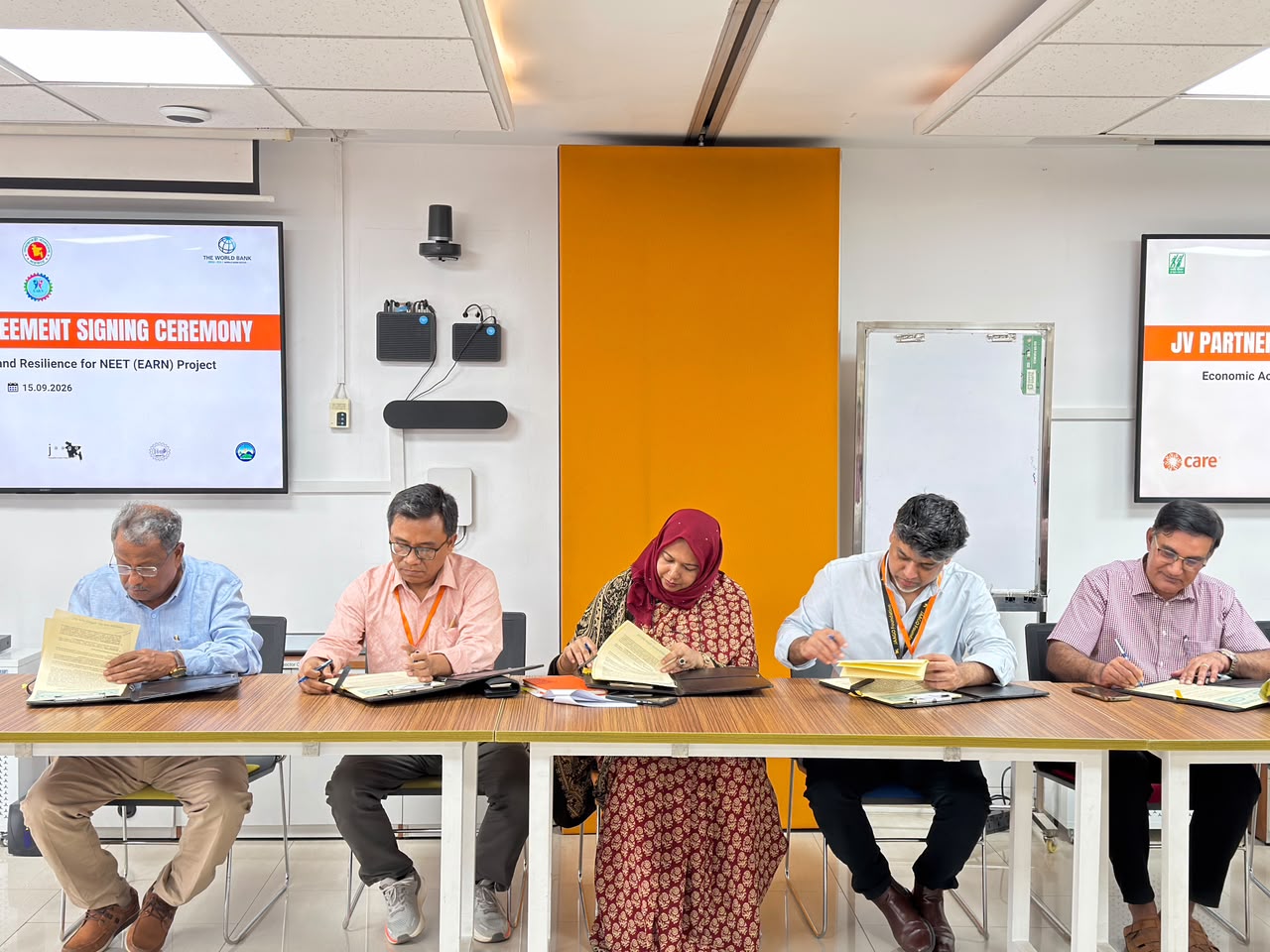
MAWTS and CARE Bangladesh Sign BDT 135.8 Million Agreement to Empower 19,600 Youth under the EARN Project
MAWTS and CARE Bangladesh Sign BDT 135.8
Million Agreement to Empower 19,600 Youth under the EARN Project
Mirpur
Agricultural Workshop and Training School (MAWTS) and CARE Bangladesh
have officially signed a landmark partnership agreement on 15th
September, 2026 to launch a massive youth skills development initiative under
the Economic Acceleration and Resilience for NEET (EARN) Project. Driven by a
total budget of BDT 135,857,471, the comprehensive training program is
officially scheduled to commence in October 2026. This project will be
implemented by the direct support of Caritas Mymensingh Region.
The
primary objective of this joint venture is to transform the socio-economic
realities of 19,600 youth who are currently Not in Education, Employment, or
Training (NEET). To achieve this target, the project will roll out a robust
curriculum combining market-driven vocational skills training with specialized
Socio-Emotional and Behavioral (SEB) / Entrepreneurship Development Training
(EDT) designed to foster self-reliance and formal employment.
By
deploying these training structures across 8 localized Upazilas in the
Mymensingh division, the initiative addresses critical access barriers for
rural youth. The dual approach of hard vocational skills alongside SEB/EDT
tracks ensures that graduates do not just receive technical know-how, but also
the critical behavioral frameworks, business development capabilities, and
mentoring required to launch successful micro-enterprises or secure sustainable
institutional jobs.
This
localized intervention forms a vital part of the overarching EARN project, a
national flagship initiative funded by the World Bank and executed by
the Department of Youth Development (DYD) under the Ministry of Youth
and Sports. The collaboration between MAWTS’ proven technical training
excellence and CARE Bangladesh’s extensive community-mobilization networks
creates an ideal framework to uplift vulnerable demographic groups and convert
potential human capital into a resilient workforce